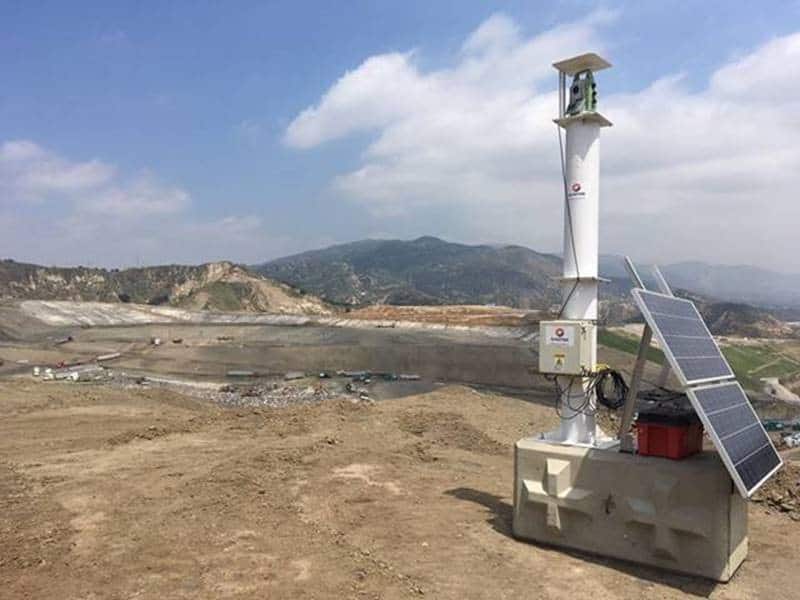
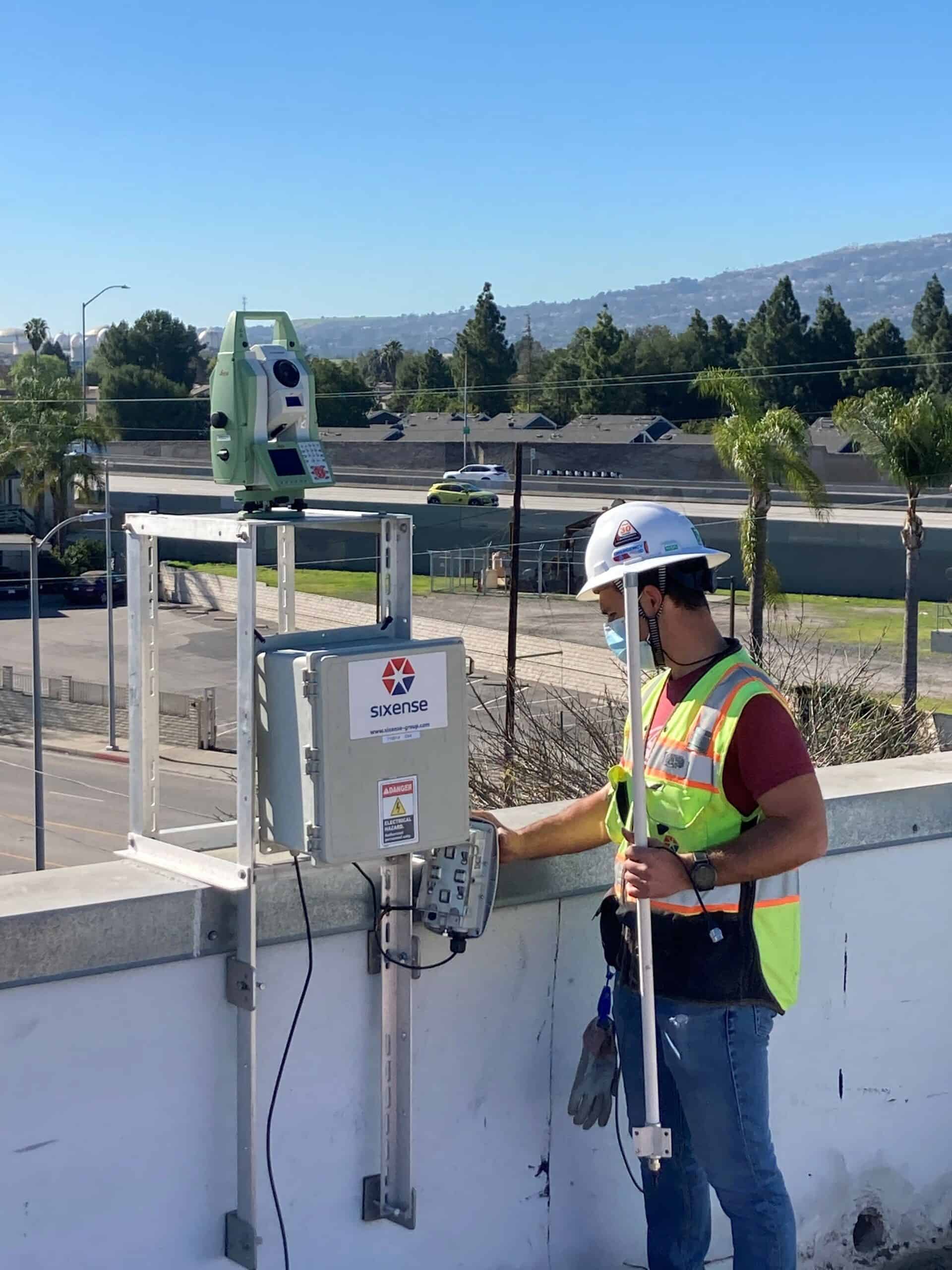
Manual survey crews can only visit a construction site periodically, leaving gaps where structural movement goes undetected between readings. Automated total station monitoring closes that gap: robotic instruments track reflective prism targets around the clock with sub-millimetric precision, turning displacement measurement from a scheduled task into a continuous, real-time process.
This guide covers the technology and system behind AMTS, from how the instrument captures angles and distances to the accuracy factors, key components, and data tracking workflow that deliver reliable monitoring on construction and surveying projects.
What Is Automated Total Station Monitoring (AMTS)?
Automated total station monitoring (AMTS) is a geodetic measurement method used to remotely track 3D displacement of structures and ground surfaces. The system relies on robotic total stations that combine two core functions: electronic distance measurement (EDM) and angular measurement of horizontal and vertical angles. Together, these two data streams calculate precise coordinates for each reflective prism target installed at monitoring points across the project site.
The entire process runs on programmed schedules. The instrument rotates automatically from prism to prism, collecting measurements 24/7 without operator intervention. A single automated total station can measure up to one hundred prism targets per cycle, which is why AMTS has become the standard surveying approach on projects that need continuous displacement monitoring.
How Do Automated Total Stations Differ From Manual Survey Methods?
A manual total station requires a surveyor positioned at the instrument and a rod person standing at each target. Data collection happens during scheduled site visits, which means movement between readings goes unrecorded. The time and labor cost of each visit limits how often measurements can be taken, especially on large projects with dozens of monitoring points spread across the field.
AMTS automation eliminates that constraint. Automatic target recognition (ATR) locks onto each prism without manual aiming, removing operator error from the measuring process. The robotic instrument cycles through all programmed targets automatically, delivering continuous data with no human presence required on site. Real-time threshold alerting means the project team receives notifications the moment displacement exceeds defined limits, not days later when the next manual survey report arrives.
Manual surveys still play a role as verification tools for AMTS results and for establishing the initial control network, but the day-to-day monitoring work runs autonomously with higher precision and accuracy. The mechanics behind those measurements come down to two core data streams: angles and distances.
How Does an Automated Total Station Measure Displacement?
An automated total station calculates 3D coordinates by measuring two quantities for each reflective prism target: horizontal and vertical angles and slope distance. The instrument captures both data streams in a single sighting using electronic sensors, then the system computes X, Y, Z positions through trigonometric calculation. Movements are detected by comparing current measurement coordinates against baseline values established during the initial control survey. This technology achieves sub-millimetric precision and accuracy under controlled conditions, making displacement detection a repeatable, automated process.
Angle Measurement With Encoded Glass Discs
Robotic total stations measure horizontal and vertical angles using electro-optical scanning of digital bar-code patterns etched on rotating glass cylinders inside the instrument. As the telescope rotates, electronic sensors read these patterns to determine the exact angular position with high precision. Best-grade instruments achieve 0.5 arc-second angular accuracy, with the range extending to 5 arc-seconds on construction-grade units.
Automatic target recognition is the technology that makes this process fully autonomous. The instrument identifies each prism’s reflective signature, locks onto the target, and records the angle measurement without manual aiming. ATR removes the variability introduced by human operators, one of the primary tools AMTS relies on to maintain measuring consistency across thousands of repeated cycles.