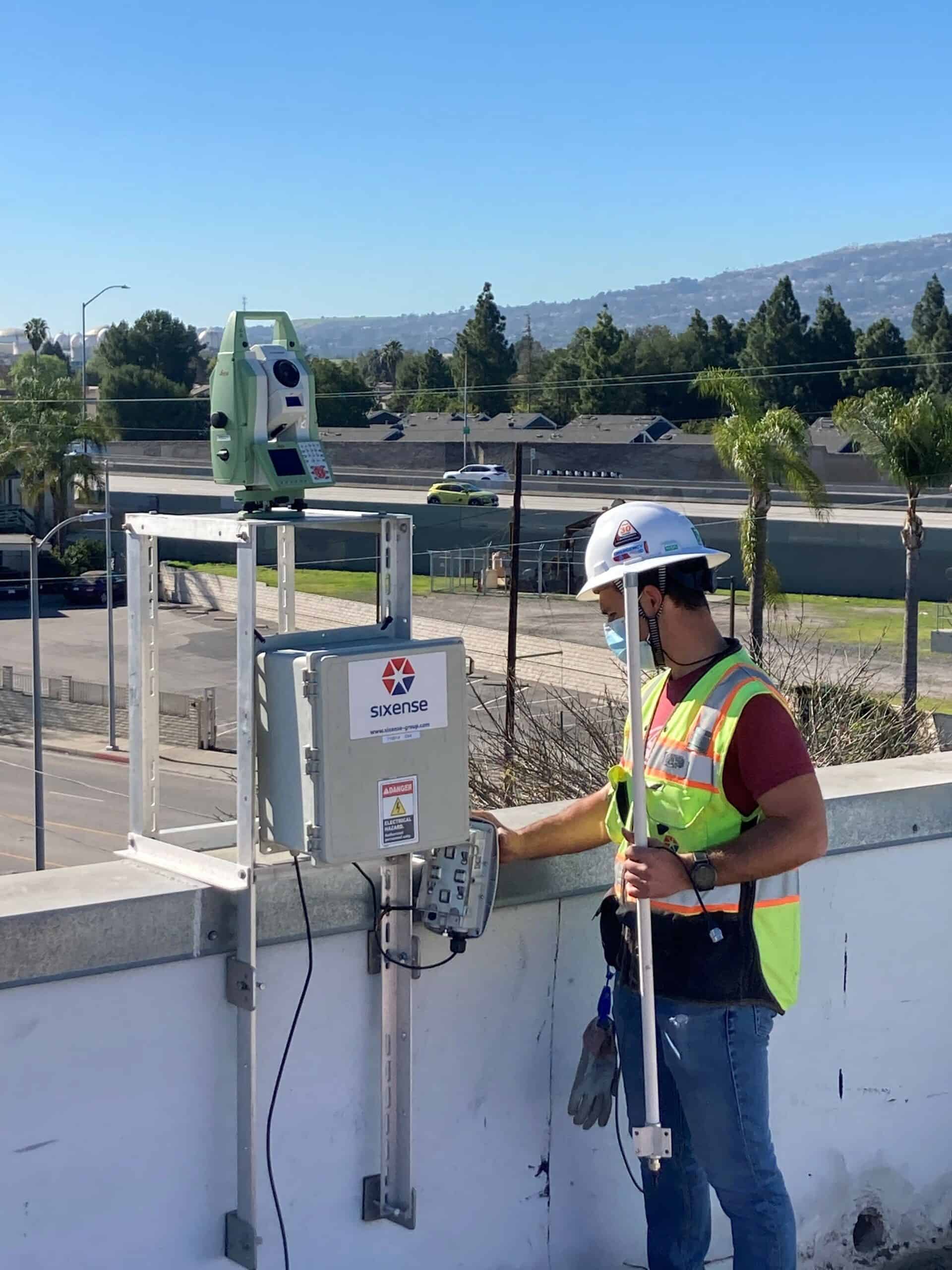
Automated motorized total station (AMTS) monitoring is accurate to sub-millimeter levels at typical monitoring distances. A high-end half-second instrument resolves angles to 0.5 arc-second and distances to about 0.6 mm + 1 ppm, and least-squares processing across repeated observation cycles tightens the delivered network result to below a millimeter. That figure is set in the instrument’s hardware before a single prism goes in the ground, not a tolerance the project dials in later. This guide covers the instrument specifications that define AMTS accuracy, the field factors that decide whether it is achieved, how least-squares processing refines the final coordinates, and how AMTS accuracy compares to manual survey methods.
What is Automated Total Station Monitoring?
An automated motorized total station (AMTS) is a robotic surveying instrument that automatically measures the precise position of fixed reference points, called prisms, on a structure or the surrounding ground. Unlike a manually operated total station, an AMTS runs unattended on a programmed cycle, aiming at each prism to measure its angle and distance, recording every measurement, and repeating the sequence around the clock.
What Accuracy Can an Automated Total Station Monitoring System Achieve?
The accuracy of an automated motorized total station is set by the instrument itself, not by the project. A high-end half-second total station delivers 0.5 arc-second angular accuracy and 0.6 mm + 1 ppm distance accuracy, the published specification for the most precise monitoring instruments on the market. Only sub-second instruments reach this level, and standard total stations with 5 arc-second or coarser angular accuracy aren’t precise enough for monitoring: the line that separates monitoring-grade equipment from general survey gear.
That hardware specification is the ceiling on precision, and no field setting raises it. What a project does define is its tolerances, the acceptable limits of movement, and its alert thresholds, the levels that trigger a notification. Both are distinct from the instrument’s fixed accuracy.
Hitting that precision in the field depends on more than the electronic equipment alone, which is why every AMTS monitoring deployment is engineered around network geometry, environmental conditions, and the data processing technology that shape the delivered result. The angle and distance components of each measurement combine to fix every prism’s position, so knowing how each behaves explains how high real-world accuracy can go.